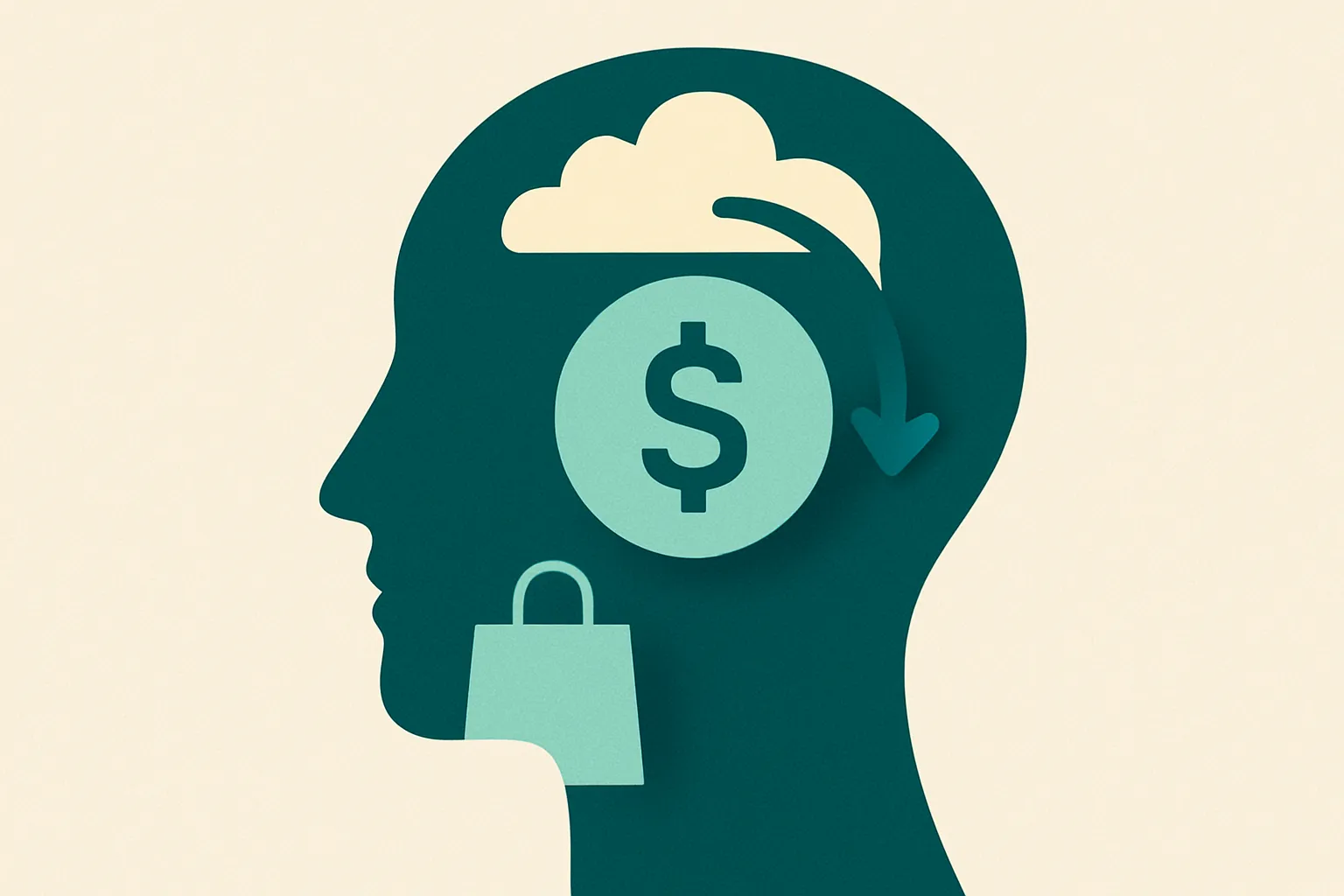
Every day, you make dozens of financial decisions — most of them on autopilot. From your morning coffee to impulse purchases during your lunch break, your brain uses a complex set of shortcuts to decide what to buy. Unfortunately, these shortcuts often work against your financial goals.
The anchoring effect is one of the most powerful biases in spending. When you see a $200 jacket marked down to $120, your brain focuses on the $80 "savings" rather than whether you need or can afford a $120 jacket. Retailers exploit this relentlessly with "original" prices that were never the actual selling price.
The pain of paying is another critical concept. Research by behavioral economist Dan Ariely shows that paying with cash creates a tangible sense of loss that credit cards eliminate. This is why people consistently spend 12-18% more when using cards. Digital payments and tap-to-pay have reduced this friction even further, making it easier than ever to overspend.
Mental accounting causes us to treat money differently based on where it comes from. A $500 tax refund might get spent on luxuries, while $500 from your paycheck goes to bills. But money is fungible — a dollar is a dollar regardless of its source. Being aware of this bias can help you make more rational allocation decisions.
The present bias makes us heavily discount future rewards in favor of immediate gratification. This is why saving for retirement feels so abstract, while a new gadget feels urgent. One powerful countermeasure is visualization: research shows that people who regularly view age-progressed photos of themselves save significantly more for retirement.
Social comparison spending — keeping up with peers — has been supercharged by social media. Seeing curated lifestyles creates a distorted baseline for "normal" spending. Studies show that social media usage directly correlates with impulse spending and financial dissatisfaction.
The good news is that awareness is the first defense. Once you recognize these patterns, you can create systems to counteract them: implementing a 24-hour rule for purchases over a threshold, using Finaps alerts to track spending in real time, and setting up automatic savings that remove the need for willpower entirely.